








Something new on ‘those PBUH’ people
Muslims often write (pbuh) after the name Muhammad or in reference to the Prophet. In English it’s an acronym for ‘peace & blessings upon him.’ In the Malay speaking world, you’d often see (saw), for the transliterated Arabic acronym of sol-lal-la-hu ‘alayhi was sal-lam which means the same as pbuh.
You’ll hear this in speech too, but in variations bearing the same meaning or impact. Allah-humma sollu alaih. Sollu-allan-nabiy. I-dha tu-hib sollu-alaih! (If you love (him) send peace and blessings upon him!) often said aloud, by one of those dudes during any brief moment of mid-silence, from a small to a huge gig.
How do you like your drink?
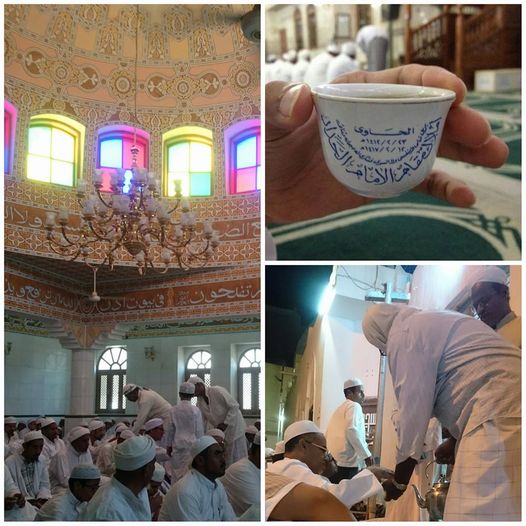
In most gatherings in Tareem, where you’re served a drink, tea comes to you on a tray of many cups and you take one. Coffee is served by a man holding at stack of cups on one hand and a pot on the other. He pours it out in front of you and you take yours, before he pours the next one for the person next to you.
This is a long standing known part of the culture that it’s not a bother to have a line of twenty pourers in front in a mosque combing their way through the crowd, while someone is at the pulpit giving a speech or reciting a religious poem.
Getting your attention.
As there’s something going on in front, you might be occupied or at times, possibly dozed off for an array of reasons. So much so that when the pourer is about to do yours, you still haven’t quite noticed it yet. So what does he do with his hands full? He does not say ‘excuse me.’ Or ‘sorry.’ Or ‘hey.’
‘Allah-humma sollu alaih.’
I was once the Finance Office of the school, where there’s also a money changer and the school’s own mini bank. People walked in and out all the time, students and local staff. Sometimes needing something from their colleague, sometimes just to say what’s up. The first thing said when the door opens, ‘sollu-alan-nabiy.’
And the whole room goes, almost in unison, ‘Allah-humma sollu alaih.’ Such appears often as well in throughout conversations regularly. This is common and the way it is. Some people call this second nature. Others call it sunnah. Some agree it’s culture.
I say it is love lived. By they the generous.
قال رسول الله، صلى الله عليه وسلم، ((البخيلُ منْ ذكرتُ عندهُ فلمْ يصلِّ عليَّ)) حديث صحيح رواه الإمام أحمد
The Messenger of God, peace and blessings upon him, said ‘The miser is he who when I am mentioned to him, refrains from sending blessings upon me.’


Zakuan Faiz